High in the Andes, where the cold is cutting and snow covers the mountains, one of Peru’s most intense displays of faith takes place: the festival of the Lord of Qoyllur Rit’i This is no ordinary celebration or urban festival. It is a demanding pilgrimage that requires conviction and a deep connection with nature.
Every year, thousands of people climb to the foothills of Nevado Ausangate, traversing high-altitude trails, to take part in a tradition that blends Andean and Christian beliefs. The experience cannot be fully understood through religion alone, but by walking, enduring and becoming part of a tradition that has endured for generations.
❄️ Meaning and Origin of the Lord of Qoyllu Rit'i
The name Qoyllur Rit’i comes from Quechua and is made up of two words:
- Qoyllur = Star or Evening star
- Rit’i = Snow
When considered as a whole, it can be interpreted as "snow star" or "snowy star".
Its origin and development are characterised by the intersection of Christianity and Andean beliefs.
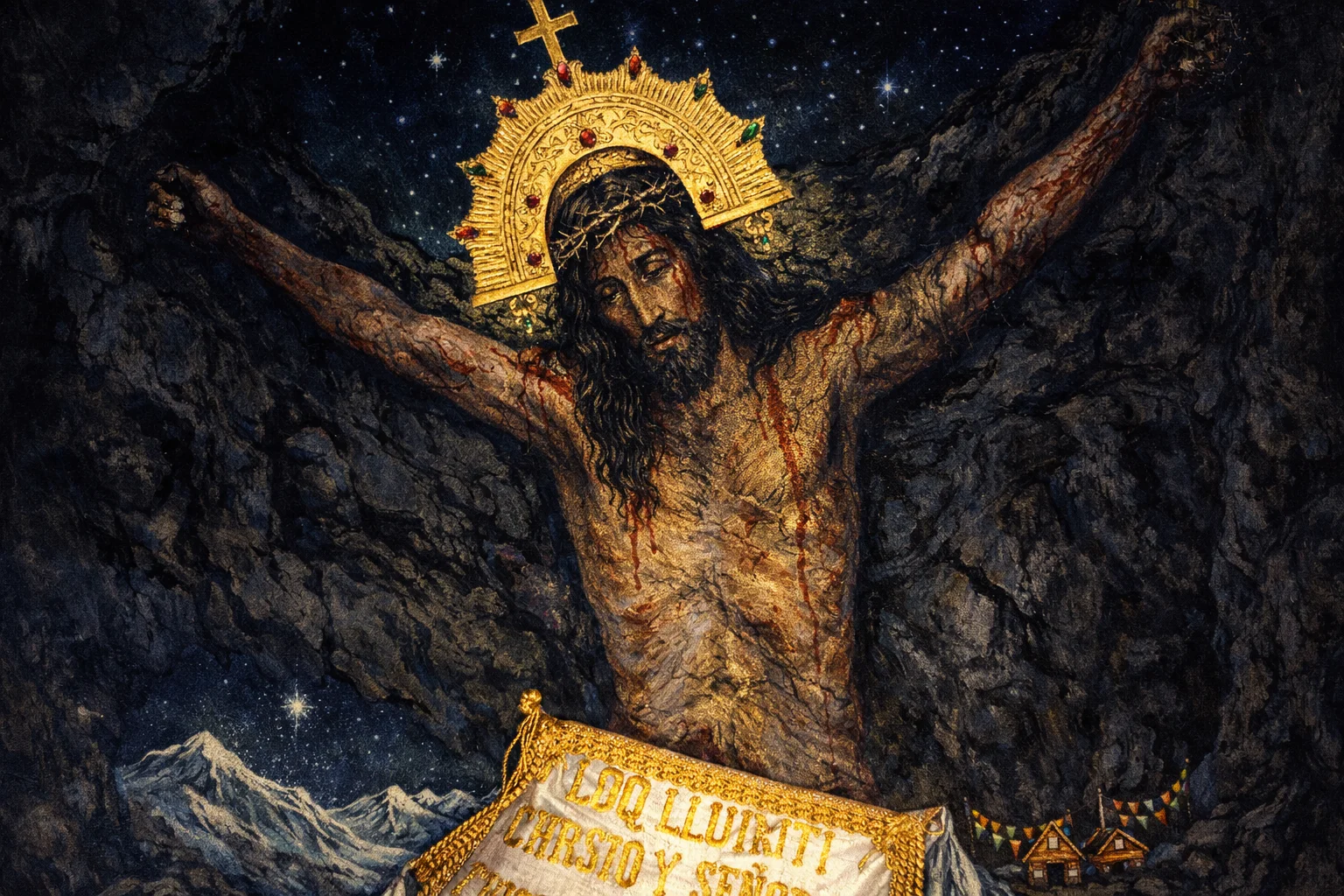
On the one hand, the image of Christ crucified is venerated at the Sinakara sanctuary. On the other hand, there is a strong connection to the apus (mountains that are considered sacred in the Andean worldview), especially Ausangate, which dominates the landscape and plays a central role in local spirituality.
This combination transforms the pilgrimage into an experience where nature, faith and culture intertwine in a unique way.
📜 The Legend of the Lord of Qoyllu Rit'i
The story dates back to 1780 and the freezing Sinakara ravine in the province of Quispicanchi.
A Quechua boy named Mariano Mayta tended his father’s herd in the cold, lonely heights of the mountains. One day, a fair-skinned mestizo boy in shiny clothes approached him and introduced himself as Manuel.
The two boys became close friends, playing together and sharing the hard daily work in the bitter cold.
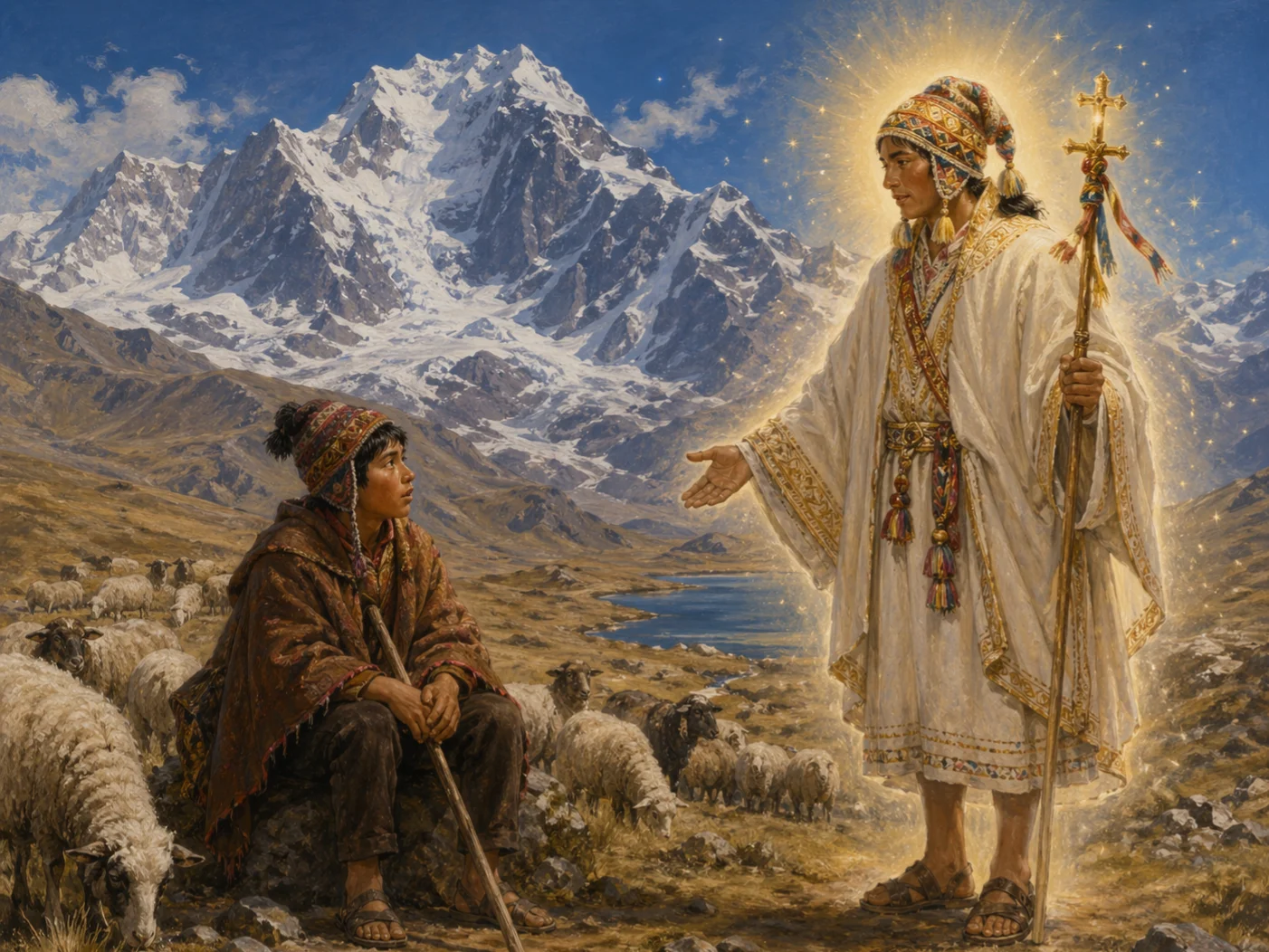
Ever since Manuel arrived, a miracle had occurred: the Mayta family’s herd had begun to multiply at an astonishing rate. When Marianito’s father noticed the sudden increase in the value of his livestock, he decided to reward his son by buying him new clothes. Deeply grateful, Marianito asked his father to buy clothes for Manuel as well.
Marianito had noticed that, despite constantly playing in the mud and snow, Manuel’s tunic never got dirty or worn out. To ensure that he could obtain the same type of fabric, Marianito took a piece of Manuel’s clothing to the city of Cusco.
When he arrived at the tailors' district and showed the merchants the fabric, they were perplexed. They told Marianito that the fabric was so fine that only the city’s Archbishop possessed garments of that quality.
This news reached the bishop. Intrigued by the story of the boy with the immaculate tunic in the mountains, the bishop decided to send an ecclesiastical commission to Sinakara to investigate and meet Manuel.
When the bishop’s envoys, guided by Marianito, reached the ravine and attempted to capture Manuel, a supernatural event occurred. Manuel suddenly transformed into a tayanca bush, and afterwards, his image was imprinted on a large rock in the form of a crucified Christ.
Marianito was so deeply shaken when he saw what had happened and believed that the bishop’s men had killed or injured his dear friend that he died of grief right then and there. He was buried beneath the rock where the image had appeared.
Since then, this sacred rock has become the sanctuary of the Lord of Qoyllurit’i and is now protected by the Ukukus, mythical bear-like creatures from the Andes.
🚶 Origin of the Pilgrimage
Following the events associated with the legend, people from various nearby areas began to visit the site where the image of the crucified Christ had appeared. What started as sporadic visits gradually evolved into organised acts of devotion.
People made their way to the foothills of Mount Ausangate to pay their respects, light candles and request protection.
As devotion grew, so did the organisation of the pilgrimage. Entire communities began to participate, forming groups that travelled together to the sanctuary.
Over the years, elements were incorporated that are now characteristic of the festival, such as traditional dances, processions and rituals, as well as the presence of characters like the ukukus, who play a special role in the celebration.
✅ Recognition as Cultural Heritage
Today, it is recognised as an Intangible Cultural Heritage of Humanity, reflecting its long history and its ongoing significance as a living expression of culture, spirituality and the relationship with nature.
This recognition has not altered its essence. Above all, the pilgrimage remains an experience deeply rooted in the communities that perpetuate it year after year.
🎆 Festival of the Lord of Qoyllu Rit'i
The date of the Lord of Qoyllur Rit’i pilgrimage is not fixed, as it is tied to the Catholic liturgical cycle. It takes place in the days leading up to the Feast of the Holy Trinity, between May and June.
It is important to note that the dates change every year, so those who wish to attend should check the specific calendar. Nevertheless, this period usually coincides with the dry season in the Andes, making access to the mountain trails easier.