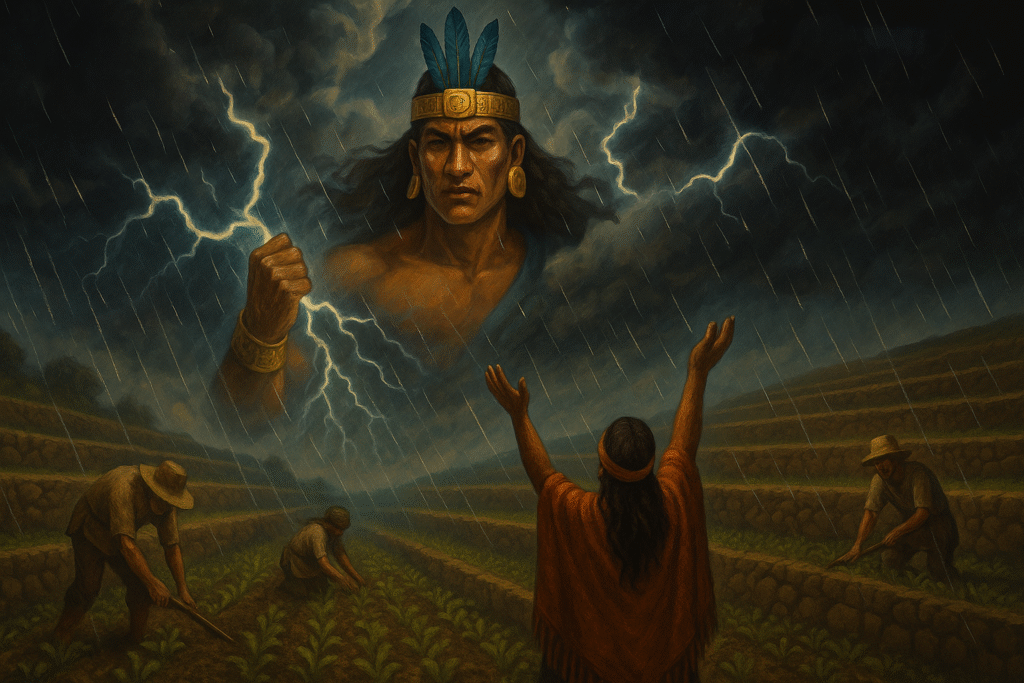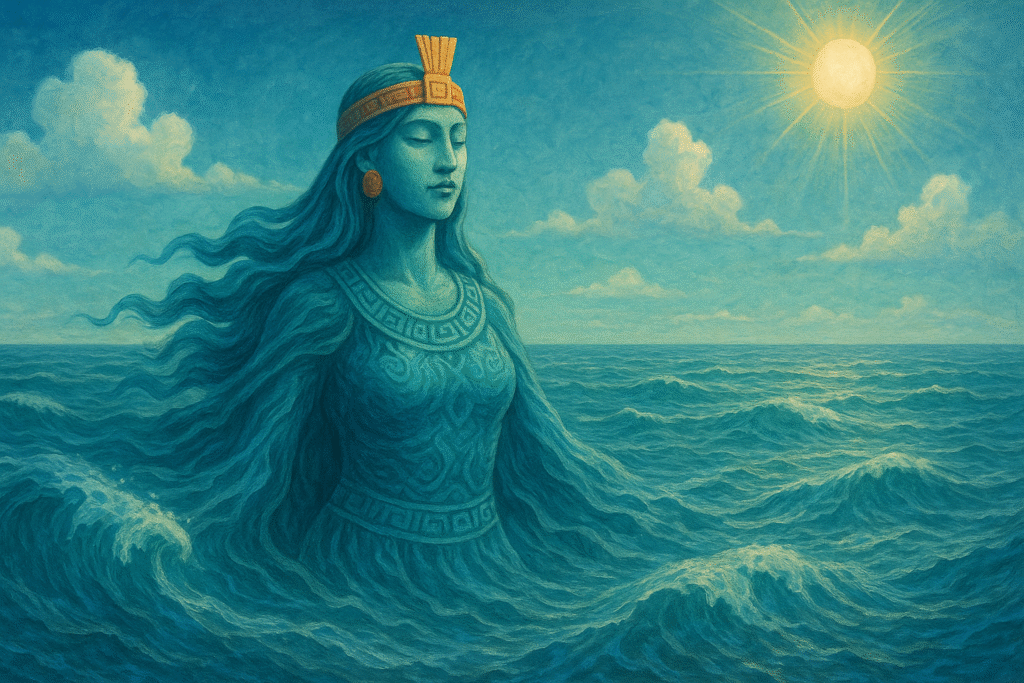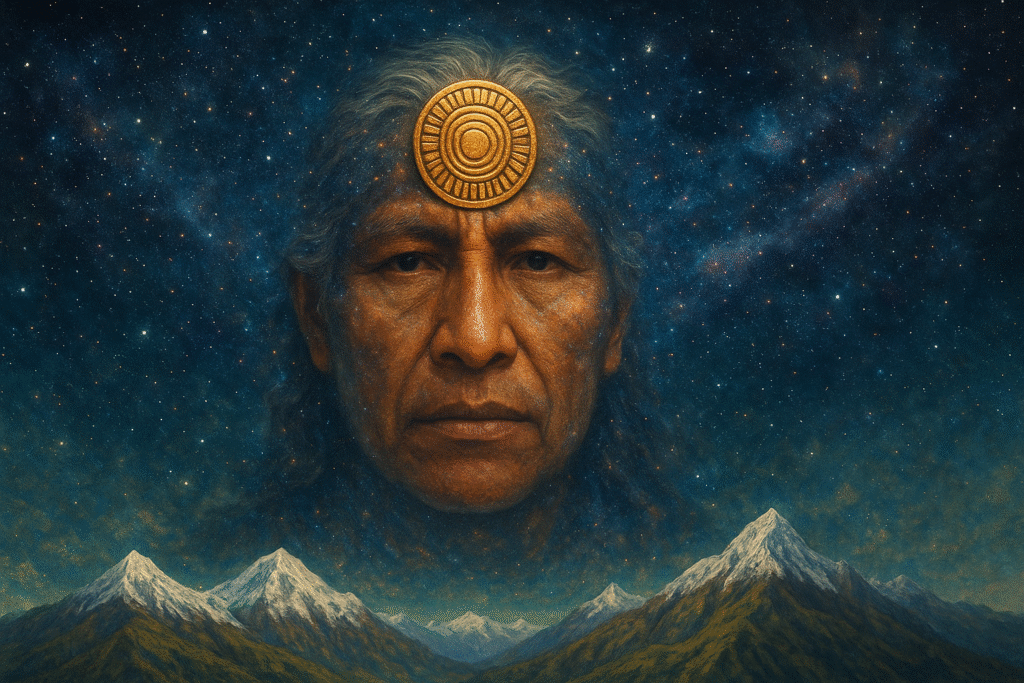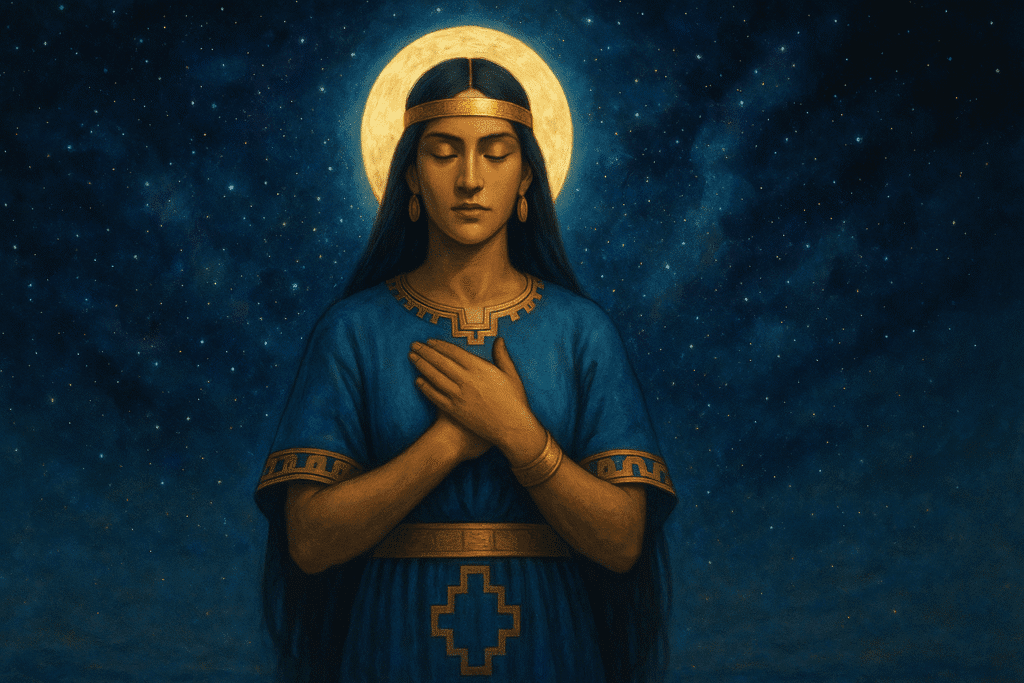
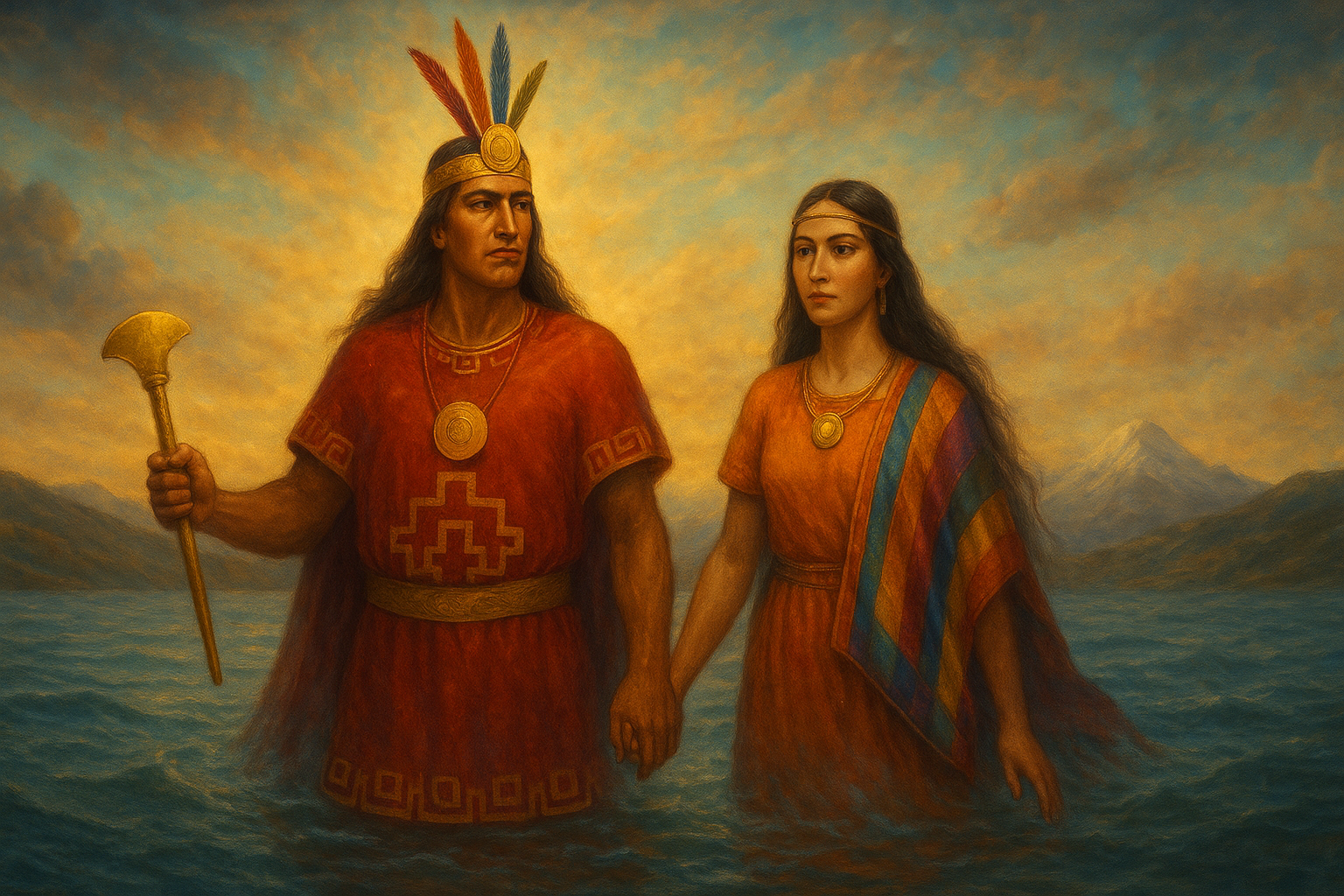
One of the most emblematic stories of the Andean world began in the sacred waters of Lake Titicaca, under the gaze of the God Inti. According to tradition, Manco Cápac and Mama Ocllo, spouses sent by the Sun God to lead humanity towards an orderly and prosperous existence, emerged from these waters.
Armed with a golden rod as a divine sign and knowledge of their celestial lineage, they embarked on a journey that would leave an indelible mark on Andean history.
🌑 The world before his arrival
Legend has it that the men and women inhabiting the Andean region in ancient times lived in a state of primitive chaos. They knew nothing of agriculture or livestock farming, had no laws or authority, wore poorly treated animal skins and ate whatever they could gather or hunt. Families lived in isolation and violence was commonplace as everyone acted according to their own will.
Seeing this situation from the heights of Hanan Pacha (the world above), the God Inti took pity on them. He decided that humanity needed guidance and instruction in order to live in an orderly manner with respect and prosperity.
☀️ The dispatch of the children of the Sun
Inti chose two of his sons to carry out this mission:
- Manco Cápac, who was strong, wise and courageous and a bearer of royal authority.
- Mama Ocllo, who was beautiful, wise and patient. She was knowledgeable about the secrets of weaving, child-rearing and domestic organisation.
The two were husband and wife, and Inti sent them to Earth, emerging from the sacred waters of Lake Titicaca — a place considered by the peoples of the highlands to be the cradle of life. They carried a magical golden rod in their hands, which would serve as a sign to indicate the location of the future heart of a great empire.
Before leaving, Inti gave them an order:
"Go north. Where this rod sinks without resistance, there you will found a city that will be the navel of the world.” From there, you will rule and teach people how to live. Tell them that you are my children, and that they must obey you as they obey me."
🌄 The journey to Cusco
Manco Cápac and Mama Ocllo began their journey from Titicaca to the north, crossing mountains, rivers, and valleys.
In each place they passed through, they gathered the inhabitants and explained their mission.
- Manco Cápac taught the men how to make tools, grow corn, domesticate camelids and construct sturdy dwellings.
- It is said that they made ceremonial stops along the way to worship Inti and give thanks for light, warmth, and life.
It is said that along the way they made ceremonial stops to worship Inti, giving thanks for light, warmth, and life.
🎯 The sign of the golden rod
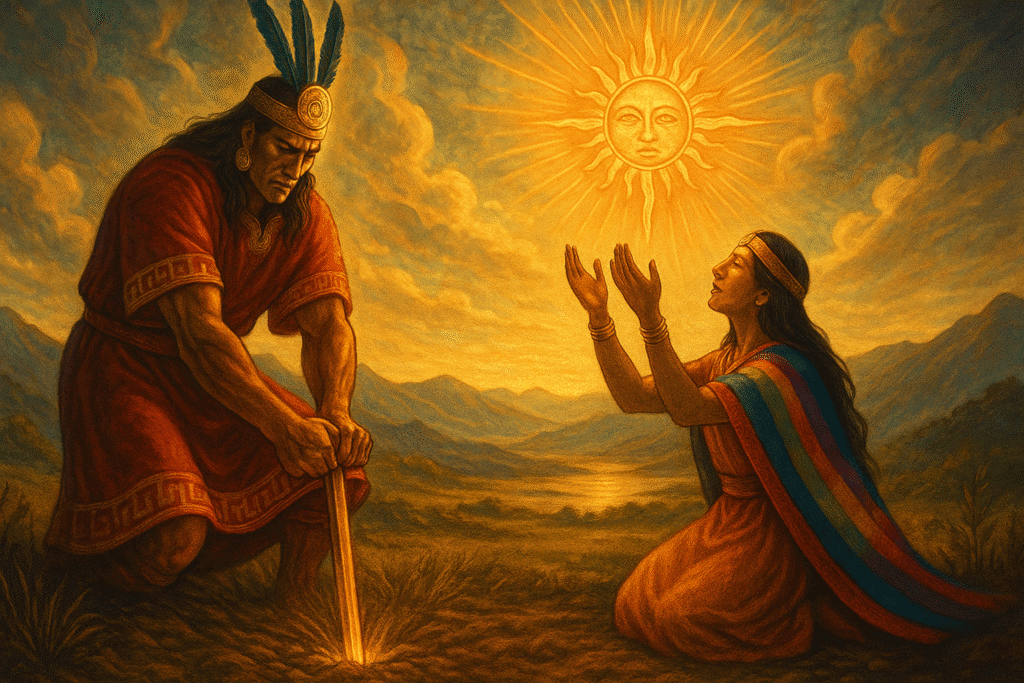
During the journey, Manco Cápac tested the golden rod at various locations. If the ground was hard, they continued onwards. After a long journey, they arrived at the fertile Huatanay River valley. There, when he stuck the topayauri into the ground, it sank until it disappeared completely. This was an unmistakable sign from Inti: this place would be the centre of the world.
At that point, Manco Capac ordered the construction of a great city: Qosqo (Cusco), meaning 'navel' or 'centre' in Quechua. From there, they would rule over neighbouring peoples and spread their culture, laws and worship of the sun. Cusco would be both the political and spiritual centre of the Andean world, with the Qoricancha (Temple of the Sun) at its heart.
🪢 The legacy
Manco Cápac became the first Sapa Inca and Mama Ocllo became the first Coya. Their lineage produced the rulers of Tahuantinsuyo, who were all considered children of the Sun.
This myth not only explains the origin of Cusco, but also consolidates the divine nature of Inca authority, which was a key foundation of their political and cultural power.
🏛 Variations on the myth
📖 Version by Inca Garcilaso de la Vega
(Real Commentaries of the Incas, 1609)
Garcilaso presents the best-known and most 'official' version of the myth, which he inherited from his Inca mother and her family.
His aim is to extol the civilising role of the Incas and depict their origin as sacred, orderly and almost conflict-free.
Key points
Origin
- Manco Cápac and Mama Ocllo were the children of Inti, the sun god, and Mama Quilla, the moon goddess.
- They emerge from the waters of Lake Titicaca.
Mission
- Inti sends them to organise the peoples who lived in barbarism, without laws, agriculture or an orderly religion.
- He gives them a golden rod (topayauri) to help them find the exact location for the capital city.
Journey
- They advance northwards, teaching communities agricultural techniques, construction and weaving.
- Manco Capac taught the men and Mama Ocllo taught the women.
Foundation of Cusco
- Upon reaching the Huatanay Valley, the rod sinks into the ground easily.
- They establish the first Inca government and found Qosqo, meaning "navel of the world".
Tone and purpose
Garcilaso presents the myth as a heroic and civilising tale, emphasising the nobility, wisdom and compassion of the Incas. He glosses over conflicts and presents a pure lineage ordained by the sun.
📜 Version by Juan Diez de Betanzos
(Summa and Narrative of the Incas, 1551–1557)
Betanzos presents a less idealised version that is closer to the original oral tradition.
His account of the journey and the episodes experienced by the characters is more detailed.
Key points
Origin
Manco Cápac and Mama Ocllo are sent by Inti from Lake Titicaca. However, in some parts of the narrative, there are references to the myth of the Ayar brothers, suggesting a fusion of traditions.
Mission
- The journey is not direct; they travel through various regions and interact with the local people.
- Betanzos mentions that some peoples resist accepting their authority. In certain cases, Manco Cápac uses cunning, while in others he uses force and threats.
Journey
More active than in Garcilaso's account, as he not only teaches, but also negotiates with communities and helps devise strategies to convince them to accept the mission.
Foundation of Cusco
- The golden rod sinks into the exact spot designated by the Sun.
- Not only does Manco Cápac found the city, he also subjugates the nearby towns to consolidate his power.
Tone and purpose
While recognising the civilising mission, Betanzos does not hide the use of power, the resistance of some towns and the mixture of mythological versions. His account is more raw and political.