During Holy Week, Cusco experiences days of profound devotion. However, one day stands out above all others: Holy Monday, which is dedicated to the Lord of the Earthquakes, the city’s patron saint. Lunes Santo, jornada dedicada al Señor de los Temblores, Patrón Jurado de la ciudad.
On this day, daily life grinds to a halt, the streets fill with the faithful and the whole city comes together to honour its patron saint.
For travellers and locals alike, Holy Monday is not just a religious celebration; it is an intense cultural experience and one of the most significant displays of faith in Peru.
❓ What is celebrated on Holy Monday in Cusco?
Holy Monday is a day of devotion to the Lord of the Earthquakes, an image of Christ on the cross that has been venerated since the 17th century. This marks the official start of Holy Week in Cusco, drawing the largest number of worshippers and activities.
Unlike in other cities, this day has particular significance in Cusco as it commemorates the protection that Taytacha is said to have granted against earthquakes and disasters.
🙏 The Lord of the Earthquakes and His Connection to Holy Monday
The connection between the Lord of the Earthquakes and Holy Monday can be traced back to the 1650 earthquake and the miracles that were said to have been performed by the image during times of crisis. This devotion gradually took root over time, establishing Holy Monday as the main day for venerating the image.
📌 Main activities of Holy Monday
Mass at the Cusco Cathedral
Masses are held continuously at the Cusco Cathedral from early morning onwards. The faithful come to ask for protection, give thanks for favours received and prepare spiritually for the procession.
The great procession of the Lord of the Earthquakes
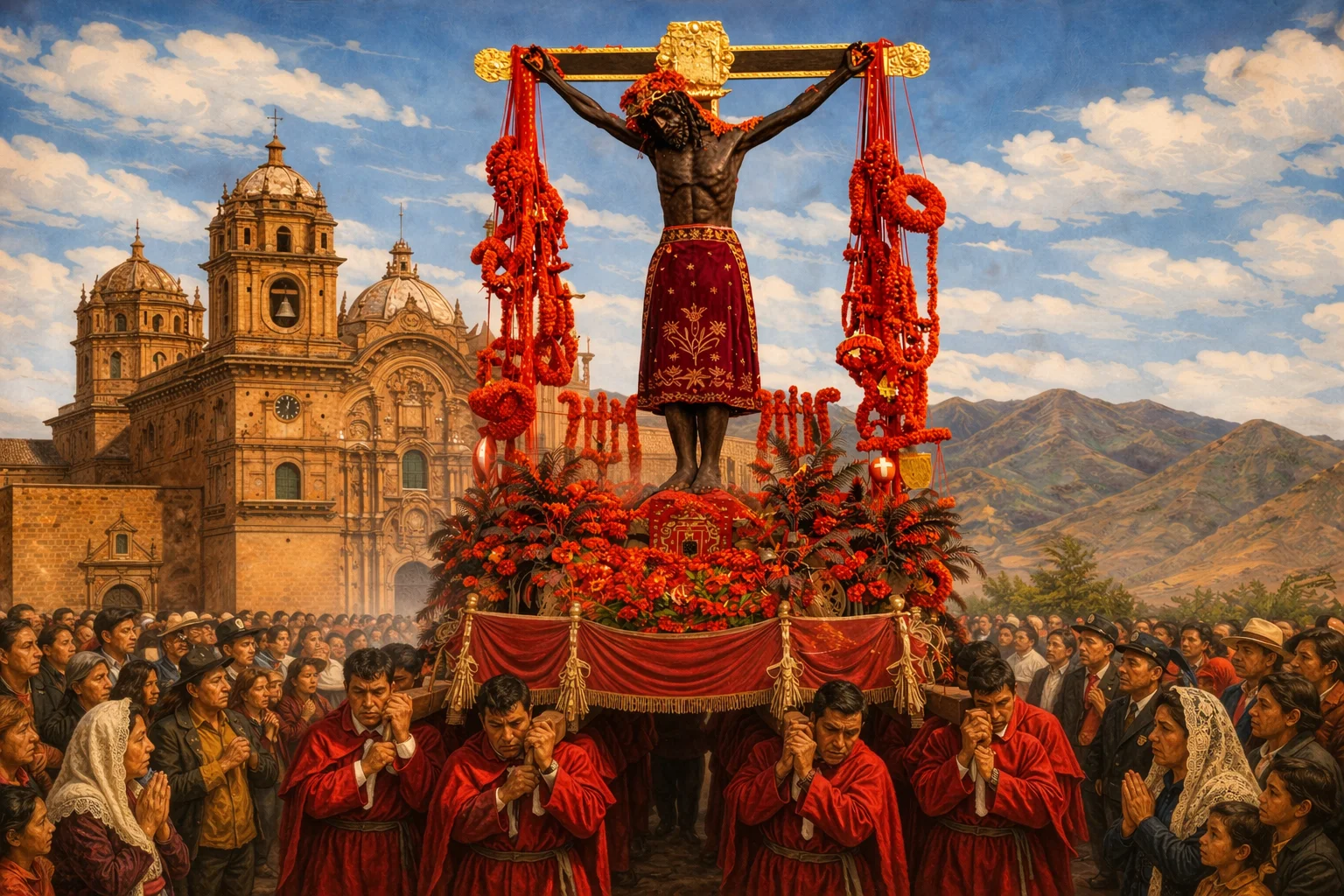
In the afternoon, the statue is carried in procession from the cathedral. Thousands of people line the route, joining in with prayers and hymns and maintaining a respectful silence. This is the day's most anticipated moment.
The blessing of the city
One of the most moving moments occurs when the image stops and blesses the city. At this point, the crowd kneels and the whole city of Cusco falls silent.
📍 Where does the procession start and where does it end?
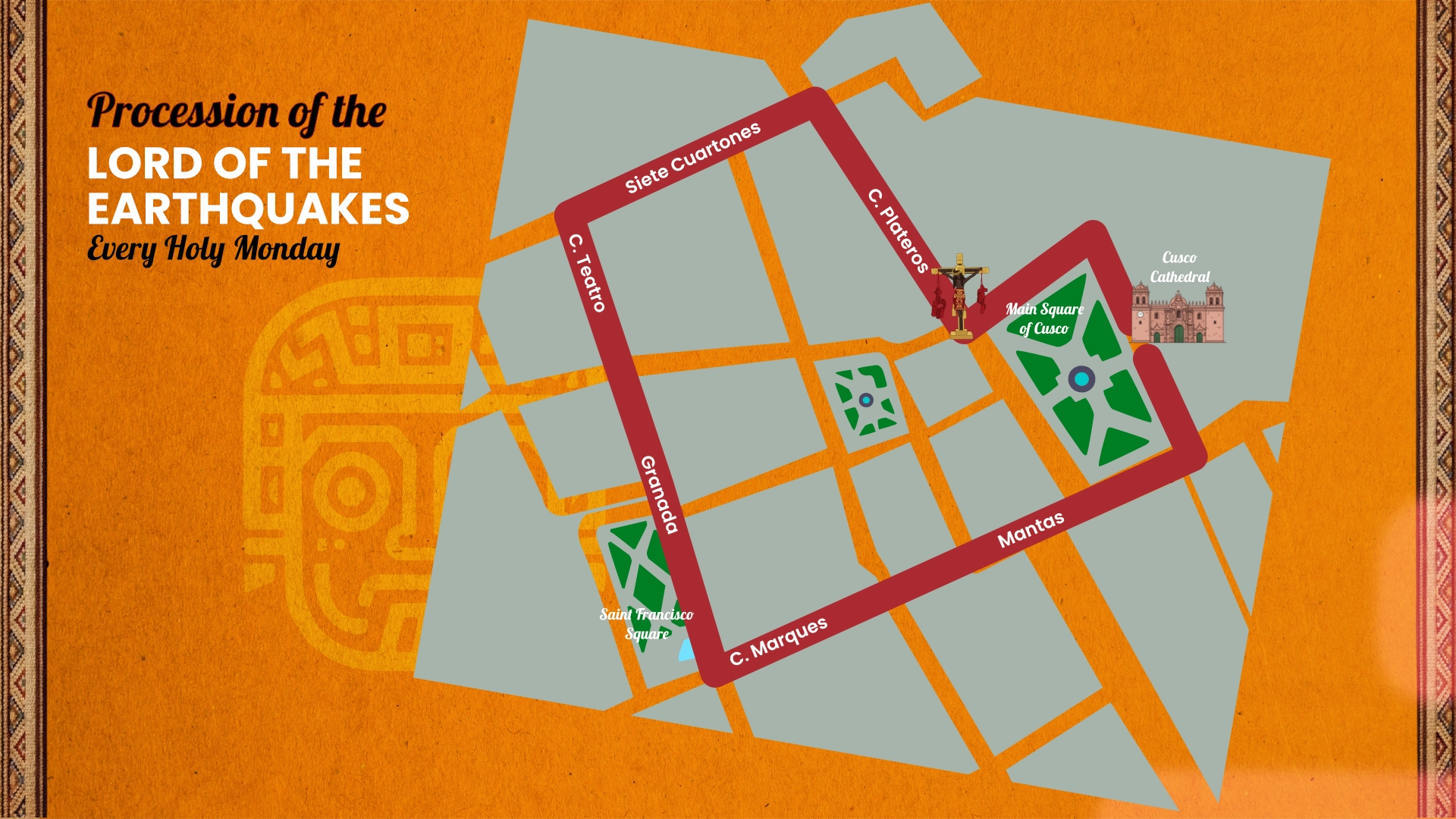
The procession of the Lord of the Earthquakes winds through the historic centre of Cusco, turning the city into a ceremonial space where faith, history and tradition converge. Familiarising yourself with the areas through which it passes allows travellers to better orient themselves and fully immerse in the experience.
The statue departs at 14:00 from Cusco Cathedral, which is located in the Plaza de Armas, the city’s central and symbolic hub. From there, the Taytacha begins a route that winds through some of the historic centre's most iconic streets.
🗺️ Main areas where the procession passes
Cusco's Main Square
Starting and finishing point. This is the busiest spot and the site of one of the most solemn moments: the departure of the Taytacha and the final blessing.
Mantas Street and Plateros Street
Narrow, traditional streets. Here, the parade passes very close to the crowd, creating an intense experience, though with more crowding.
Marques Street
A key section of the route. You can see the slow progress of the litter, the bearers, and the organization of the brotherhoods.
San Francisco Square
This is one of the most highly recommended spots for visitors. It’s a spacious plaza with better visibility and fewer crowds.
After passing through this area, the procession finally returns to Cusco Cathedral, bringing to a close a 6 hours route that attracts tens of thousands of people.
🧭 ¿Dónde ubicarse si eres visitante?
- San Francisco Square: Ideal if you want space and a more comfortable view.
- Side streets of the historic center: They allow you to watch the procession without the crowds in the Plaza de Armas.
- Main Square: Recommended only if you arrive well in advance and are prepared for large crowds.
🫢 Curiosities and symbols of the Lord of the Earthquakes
There are details that go unnoticed during the festivities. Here we reveal what they are:
Ñucchu
The red flowers that cover the image and that the faithful throw from their balconies are called Ñucchu.
During the Inca period, this flower was considered sacred and used as an offering to gods such as Inti, the Sun God. Following the arrival of Catholicism, its deep red colour came to symbolise the blood of Christ.
His crown and shroud
The crown that she wears during the procession is made of 18-carat gold and is adorned with precious stones. It is heavy. However, various versions have been made over the centuries (some gold-plated silver) to preserve it.
She also has an impressive collection of silk and velvet shrouds, which are embroidered with gold thread. These are replaced every year.
His dark complexion
Although it was originally a lighter image, its current dark color is due to the soot from thousands of candles and tapers that have been lit in front of it for over 300 years.
Its “ever-changing face”
Many devotees claim that Taytacha's expression changes during the procession. They say that if his face appears darker or 'angry', it is a sign that a difficult year is approaching, whereas if it appears lighter or calm, it is a sign that prosperity is coming.