
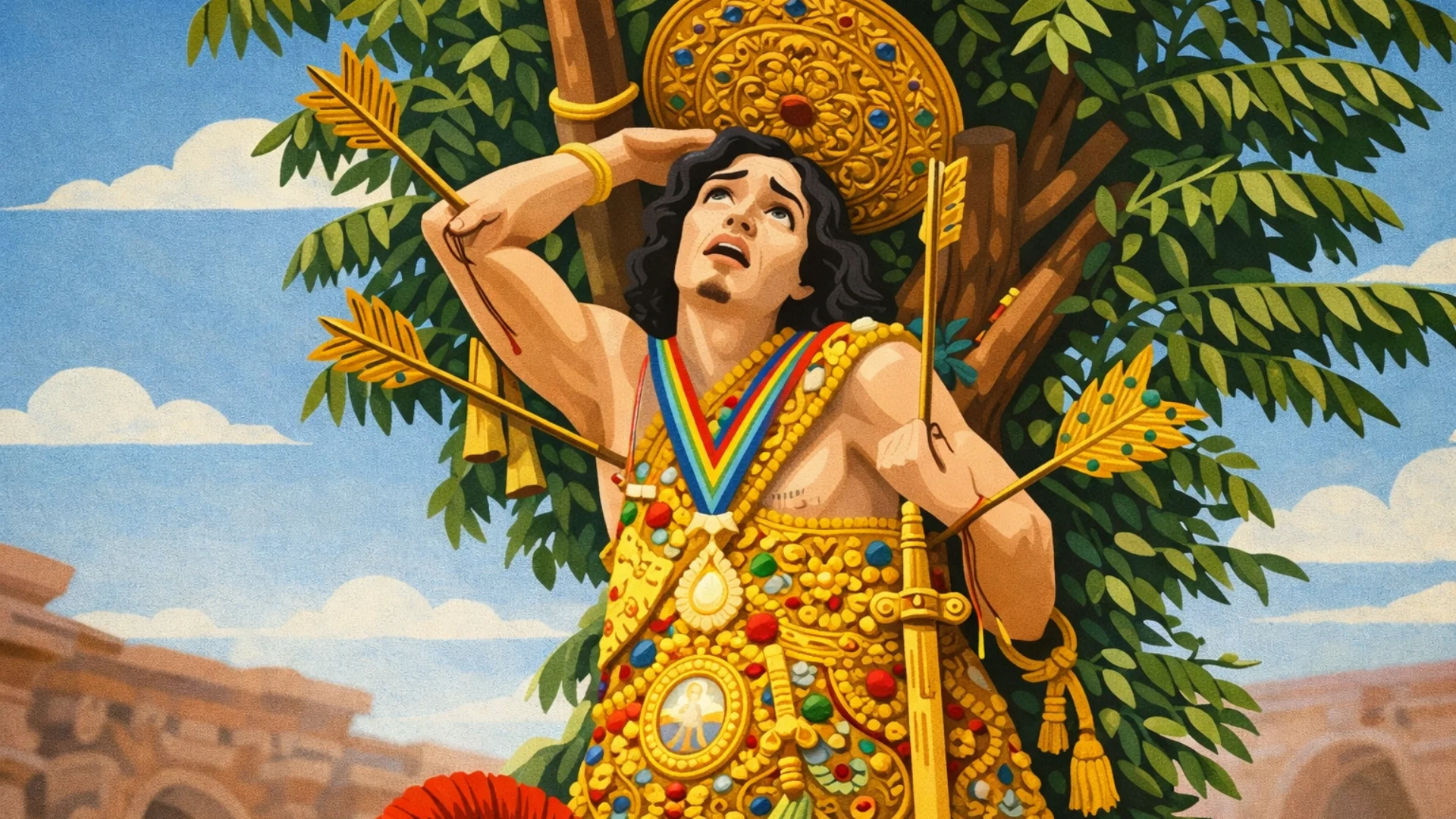
Before he became a patron saint, Saint Sebastian was a man who lived during one of the most difficult periods for early Christians. His story dates back to the heart of the Roman Empire, when declaring oneself a Christian meant directly challenging the established order.
Not only did the life and martyrdom of Saint Sebastian shape the image of a saint, they also gave rise to a devotion that has spread over the centuries, crossing borders, cultures and continents to reach places as far away as the Andes.
📜 Who was Saint Sebastian?
Saint Sebastian was born around the third century (between 255 and 256) in Narbonne, which is now part of France. However, he spent most of his life in Milan. He lived at a time when Christianity was still being persecuted and practised in secret, with the penalty for doing so being death.
From a young age, Sebastian embraced the Christian faith, but quietly. He lived between two worlds: the world of Roman power and the world of a spirituality that flourished in secret.
He was appointed centurion and head of the first cohort of the Praetorian Guard, receiving the support of Emperors Maximian and Diocletian thanks to his exceptional military skills and his notable bravery, loyalty and intelligence. He thus walked among the most powerful men in Rome.
While he fulfilled his duties as a soldier, he avoided participating in idolatrous Roman acts. Instead, he sought to strengthen the faith of captured and imprisoned Christians, a fact that did not remain hidden for long.
First Martyrdom
When his Christian faith was discovered, he was swiftly punished. Emperor Maximinus ordered his execution. Giving him one last chance to save himself by renouncing his faith, Sebastian affirmed his beliefs before Maximinus.
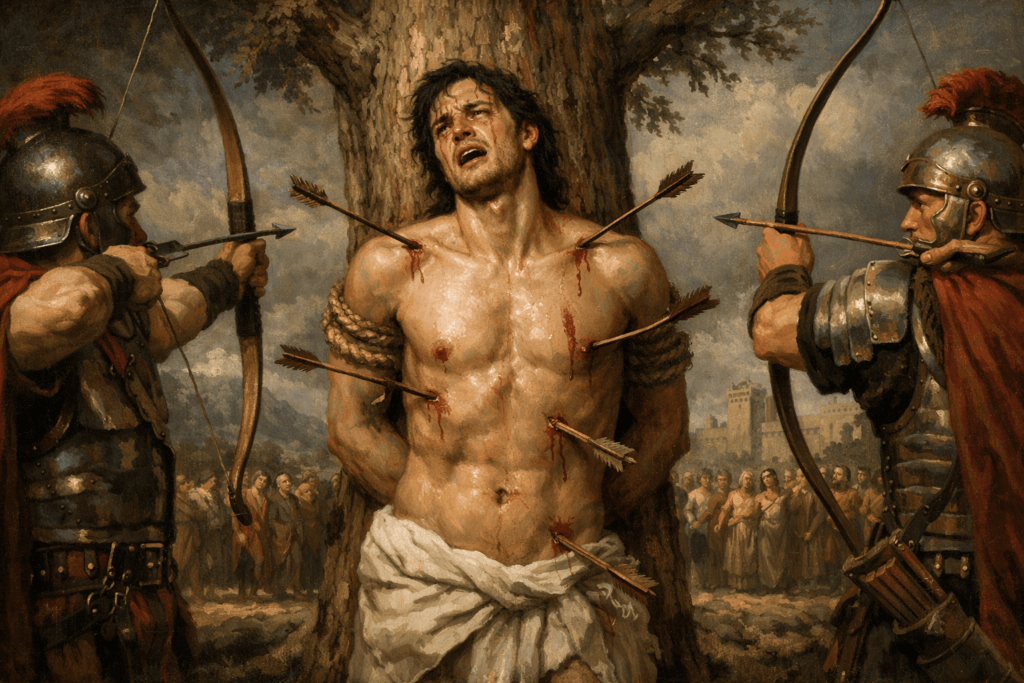
Maximinus then ordered Sebastian to be tied to a stake and shot with arrows, intending not only to kill him, but also to set an example.
His wounded and pierced body was left abandoned. But death did not come. He was rescued by acquaintances and taken to the house of Saint Irene, where he was cared for in secret.
Second Martyrdom
Despite his miraculous recovery, Sebastian did not flee. Instead, he returned to the emperor to reproach him for persecuting Christians.
This time, the sentence was final. He was whipped and beaten to death, and his body was thrown into a well to prevent it from being venerated. However, as with all memorable stories, his memory could not be erased.
Devotees rescued his body and buried it properly on the Appian Way, and his death was recorded in 288.
🙏 The spread of His devotion throughout the world
During the Middle Ages, Saint Sebastian was invoked as a protector against plague and disease, particularly in Europe.
The arrows that pierced him came to be seen as symbols of the evils that befall humanity, and his resistance as a form of protection against them.
Churches, chapels and brotherhoods adopted his name. His cult spread far and wide:
- Guipúzcoa in Spain. He is celebrated in its capital, Donostia/San Sebastián, during the Tamborrada festival.
- It also spread to Italian cities such as Acireale, Caserta and Petilia Policastro.
- Qormi in Malta. Saint Sebastian is the co-patron saint of the city, alongside Saint George.
- Rio de Janeiro, Brazil. He is also related to the Umbanda religion.
- In Peru, it is celebrated in two districts: San Sebastián in Cusco in the south, and Chepén in La Libertad in the north.
🌄 Saint Sebastian and his arrival in the Andean world
The image of Saint Sebastian arrived in America with evangelisation. In the Andes, his figure found a new symbolic space in syncretism, where the Christian faith interacted with ancient concepts of sacrifice, protection, and connection to the sacred.
Consequently, Saint Sebastian ceased to be merely a Roman martyr and became a patron saint and focal point of community celebrations. In Cusco, for example, his feast day marks the start of the annual festive calendar.